The AI adopters are hiring more, not less
Demand for the most AI-exposed roles fell 42%, yet the companies actually adopting AI grew headcount 27% more than the ones that didn't. What that means before you freeze a req.
 Tony Buffum
Get this in your inbox every week. Join 26,000+ subscribers.
The companies adopting AI fastest are hiring more, not less
This week the data stopped agreeing with the narrative. Demand for the most AI-exposed roles is down 42%. In the same dataset, the companies actually adopting AI grew headcount 27% more than the companies that did not.[1]
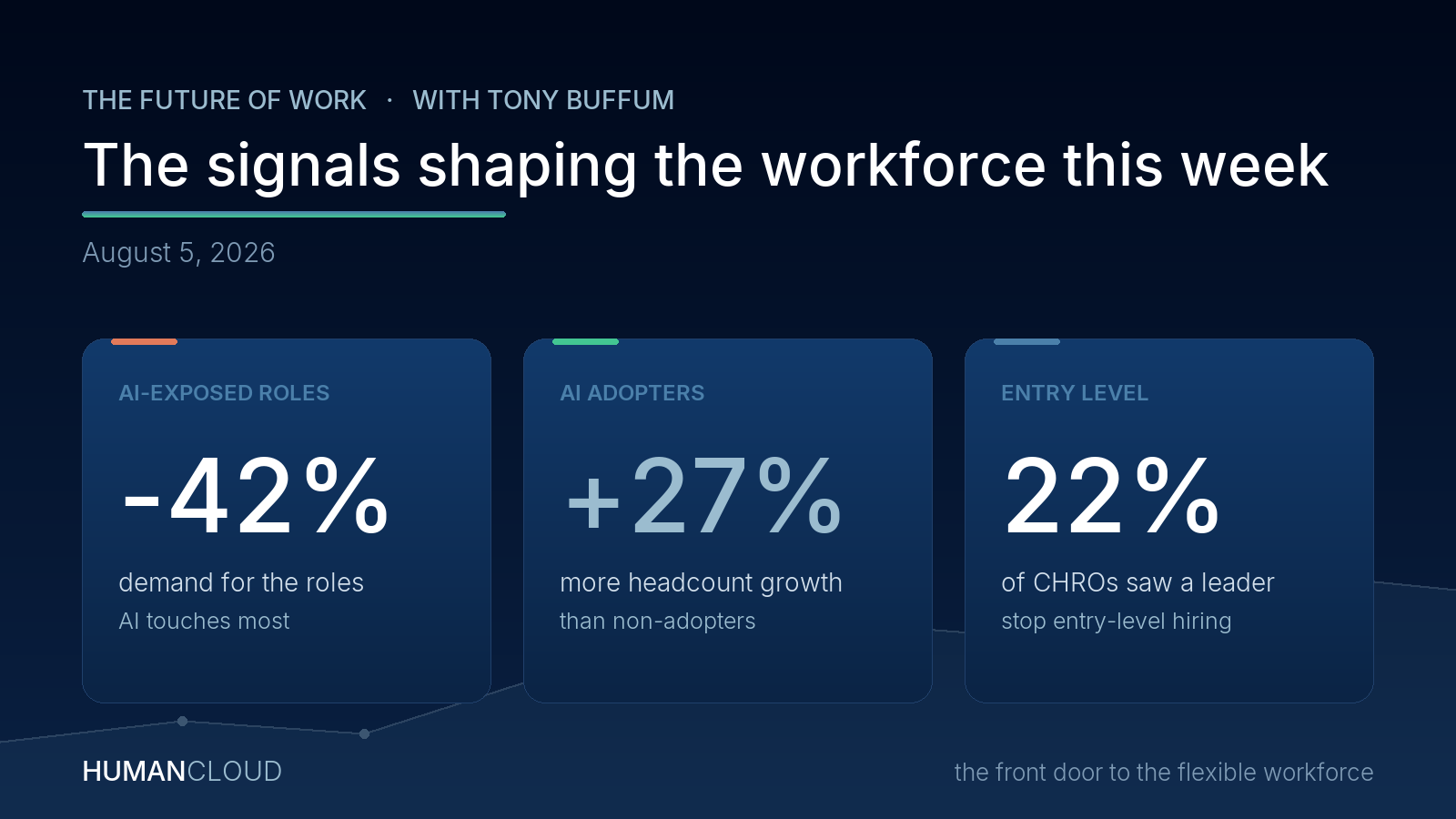
Three signals shaping the workforce this week.
Here's what I'm watching this week (Access all stories):
- Demand for the most AI-exposed roles fell 42% over the past year, while AI-adopting companies grew headcount 27% more than non-adopters. It now takes 5.05 job postings to make a single hire.[1]
- 22% of CHROs say at least one business leader has stopped entry-level hiring because of AI. 95% have implemented AI. Only 20% report significant value from it.[2]
- Visa cut 2,600 jobs, 7% of its workforce, in an efficiency push tied to AI. The same week, US staffing hours posted their strongest growth since 2022.[3][4]
Here's what I think this means for the industry:
- AI is not shrinking your workforce. It is changing what you buy. The 42% and the 27% are the same finding from two ends. Work that looks like a prompt is getting bought less. Companies that actually deployed AI needed more people around it, not fewer.
- The entry-level freeze is the expensive mistake in that Gartner number. Nearly everyone has implemented AI. One in five is getting real value from it. Cutting the bottom of your pyramid for a technology that has not paid out yet trades a five-year talent pipeline for a one-year cost line.
- Five postings per hire is the signal nobody is quoting. Hiring did not get cheaper this year. It got harder to close. A permanent req is a slow instrument in a market where it takes five swings to land one person.
- Visa and the staffing number are one move, not two. Cutting permanent headcount while flexible hours hit a four-year high is not a contradiction in the market. It is the trade, already being executed, by companies that decided which capacity they want to own and which they want to rent.
Here's how Human Cloud is helping:
The hardest part of this trade is that nobody wants to be first, and nobody wants to say out loud what it is costing them. That is what the executive community is for. It is a closed group of leaders installing flexible talent models in their own organizations right now, comparing real numbers and real failures, not vendor slides.
|
The second thing that helps is skipping the discovery call entirely. An RFP puts the exact need in front of the people who can answer it, instead of burning a quarter on vendor analysis and back-to-back intros. If you want to see how fast a real answer can come back, look at EOR pricing without talking to anyone.
And if you want a partner who builds the model alongside you rather than taking it over, that is what our advisory work is. You keep ownership of your workforce and the decisions about it. The point is that you run it, not that someone runs it for you.
We'd love to see how we can help. Reply here or find a time with us here »
- Tony
|
Tony Buffum Co-Founder & Chief Strategy Officer at Human Cloud. 20+ years in global HR and talent transformation. Former CHRO at FLIR Systems, VP HR at Stanley Black & Decker, VP HR Client Strategy at Upwork. Grab time with me » |
|
PS: I'm opening 3 podcast slots for executives using flexible talent across their organization. Reply and I'll get you scheduled. |
Human Cloud Data
Your peers stopped shopping for "AI"
Every 55 seconds, someone is evaluating a solution on Human Cloud. Below is what our data is saying about where the workforce is going.
What the data shows
Searches for AI itself fell by half this month. Searches for automation doubled. That is not a retreat from the technology, it is buyers getting specific about it.
The pattern holds across the board. In the last full week, roughly 85% of searches on the platform were for a different category than the one before them. Companies are not shopping for "AI" or "consulting" any more. They are shopping for the exact process they want taken off their plate, and the operator who has already done it in their industry. The generic category is losing to the exact fit.
| Automation | +100% this month |
| Advisory Consulting | +100% this month |
| Strategy, Finance & Operations | +50% this month |
| Consumer Electronics | -33% this month |
| Technology SaaS | -33% this month |
| Engineering | -33% this month |
| Public Sector | -40% this month |
| AI | -50% this month |
| Healthcare and Life Sciences | -62% this month |
Percentages are this month vs last month.
|
Want to take action? Launch an RFP for your biggest challenges. Need GCP-certified DevOps engineers? There was an RFP for that. An FMS layer that plugs into the contingent ecosystem you already run? There was an RFP for that. Launch an RFP → |
Sources
[1] Revelio Labs - AI Labor Market Tracker, US, July 2026
[2] Gartner - AI Automation Is Reducing Some Entry-Level Hiring at Nearly One Quarter of Organizations
[3] CNBC - Visa Is Cutting 7% of Employees in Efficiency Push as AI Reshapes Work
Get insights like this every week
Join 26,000+ leaders staying ahead of the flexible talent market.