The Fractional Wave Has Formed
Like AI, the flexible workforce is hitting its inflection point, with the latest Fractional Work Report showing why.
 Matthew Mottola
Get this in your inbox every week. Join 26,000+ subscribers.
I've seen 3 big waves transform work: gig (2016ish), then freelance (2019ish), then talent marketplaces (2021ish).
In all three, the wave rose then fell, with VC and M&A showing the clear picture.[1]
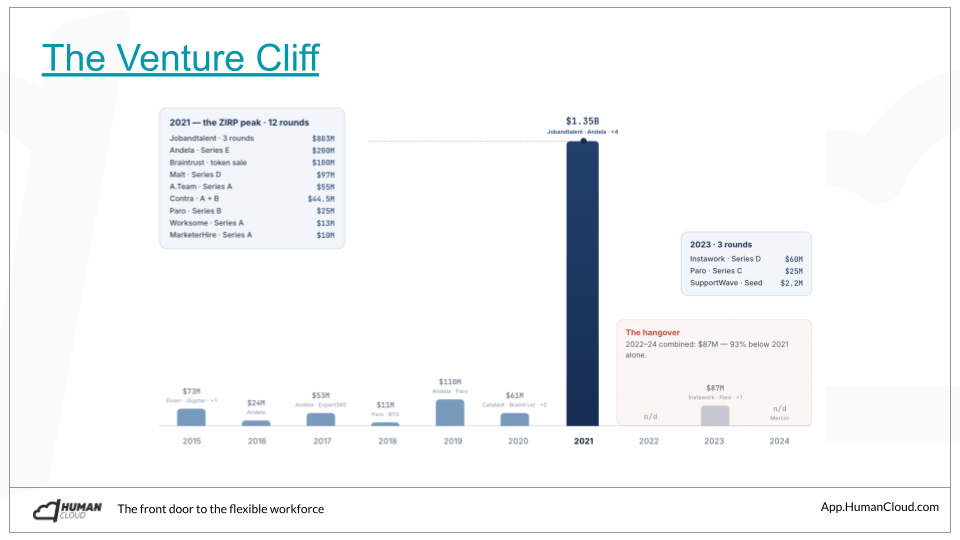
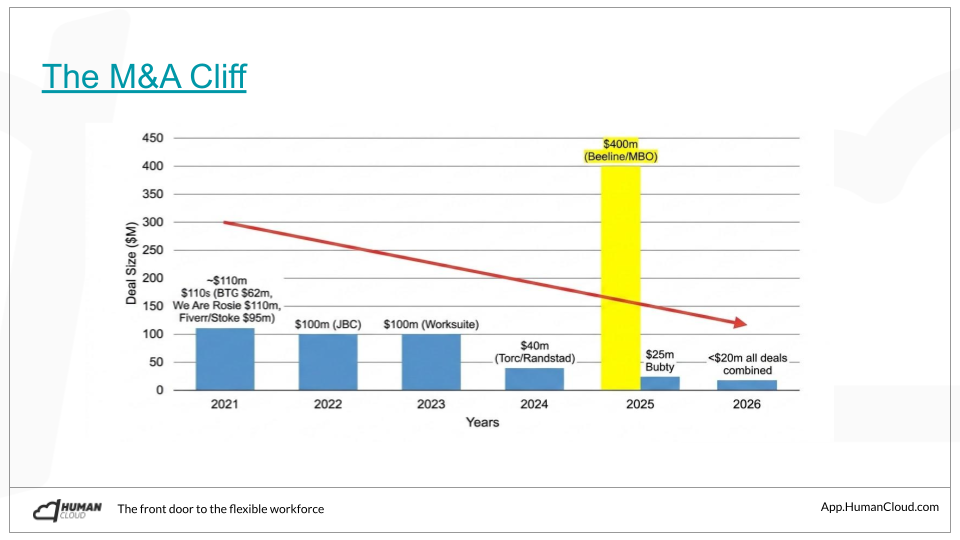
But instead of falling into nothing like NFTs, each wave pushed the future of work forward toward flexible, digitally delivered, outcome-based work. What we call the flexible workforce.
The data makes this falling forward clear.
- 72.9 million Americans now work independently, with 67% saying they feel more secure than they did in a traditional job, and 80% planning to stay independent. And the incomes follow, as 5.6 million now make over $100K, up 86% since 2020[2]
- Platforms are thriving, with Gigged.AI citing 52% month-over-month revenue growth from May to June, and 284% revenue growth over the last 12 months[4]
- The industry keeps growing. There's now 3k+ flexible talent solutions on Human Cloud, while the industry maintains its 17%+ industry CAGR[3]
And this pattern of falling forward isn't unique to the talent industry. The AI industry had deep learning, machine learning, neural networks and more before LLMs created the environment for mass adoption.
When we wrote the Human Cloud book, AI was in the machine learning wave. That's why section 1 was the "human" cloud and section 2 was the "machine" cloud.[5]
Now there's a new wave: Fractional.
Like gig and freelance, the concept isn't new. It's still independent contractors working on a scoped, project, or outcome basis. And there are already entrenched comparables: executive search, expert networks, and more.
And also like gig and freelance, the data is clear. Everything below comes from Fractional Jobs' The Fractional Work Report 2026, built on 1,447 tracked job postings, 44,433 member profiles, a survey of 1,733 fractional workers, and 166 client discovery calls:[6]
- There are roughly 150,000 fractional executives in the US today, on track for ~370,000 by 2030 at a 15-25% growth rate
- Fractional job postings went from 14 a month in Q1 2024 to 112 a month in Q1 2026. Q1 2026 ran 149% above Q1 2025
- 83% choose to be fractional for the flexibility, while 14% go fractional because they couldn't find a full-time job, and 34% have turned down a full-time offer from a client
Which brings up an important milestone: the flexible workforce now covers the full scope of work, from entry level tasks, to highly complicated initiatives.
And brings up the question...
is fractional a term like gig and freelance, or its own unique structural change?
My quick answer: who cares what it's called. It's obviously a change companies should embrace, and it covers the strategy and execution layer of your workforce. And what's unique beyond any term is the combination of flexibility, strategy, AND execution, as 91% of fractional executives do hands-on work inside their engagements.[6]
What's more important to ask - what are the implications if fractional follows the same fate as gig and freelance?
What's in its way
Across the next three sections, remember that my views are shaped by seeing $1B+ of flexible talent spend across the team at Human Cloud. From Microsoft, to Stanley Black & Decker, to large religious institutions, we've scaled this workforce in the most sensitive, regulated, and complex industries.[3]
Is there anything technologically different about fractional? No. It's just a term describing the type of contract and collaboration.
And like gig and freelance, adoption and success of fractional are material in startups and small businesses. But in complex settings, it fails to scale above 1-10% of a company's total talent spend.[3]
The Fractional Work Report 2026 shows this plainly. Public companies are 1% of fractional job postings. PE-backed are 2%. Late-stage is 1%. Meanwhile early-stage VC-backed companies are 36%, and venture-backed companies overall are nearly half the market.[6]
The category is thriving exactly where governance is light and stalling exactly where it isn't, just like gig and freelance.
The common reasons gig and freelance didn't scale:
- The risk is real, and beyond what any one solution can protect against
- There are no standard roles or playbooks, so success comes from champions across the business, procurement, or HR, and fails when that leader leaves
- There's no clear ownership. Does procurement own company-wide success? Or HR? Or is this its own function?
Microsoft described it like this (I know, very researchy):
While freelance platforms reduce many administrative burdens, there are a number of conditions in which using freelance platforms in a corporate context creates high transaction costs. Ultimately, these transactions costs are a potential barrier to wider adoption. If corporations want to leverage the value of the freelance economy then better guardrails, guidelines, and perhaps even creative technology solutions will be needed.[7]
We describe it below.[8]
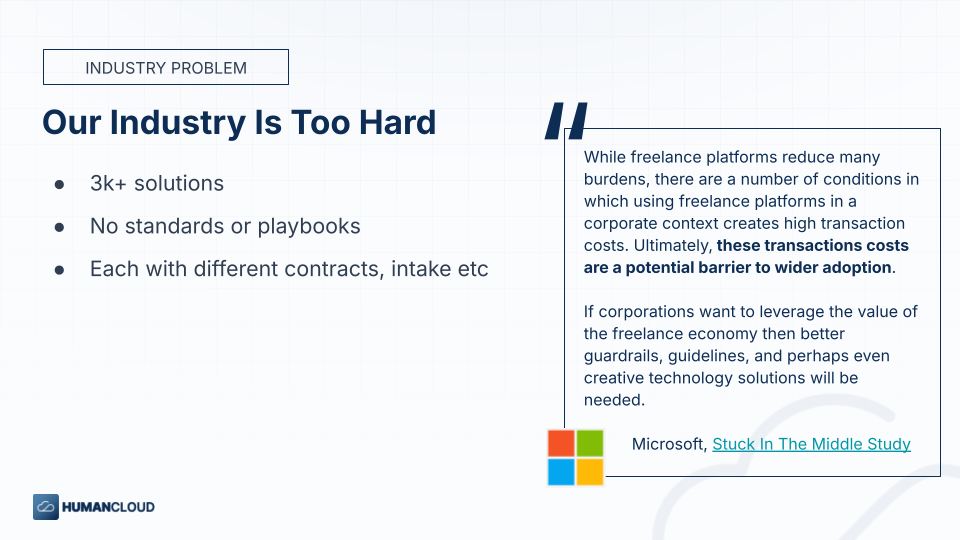
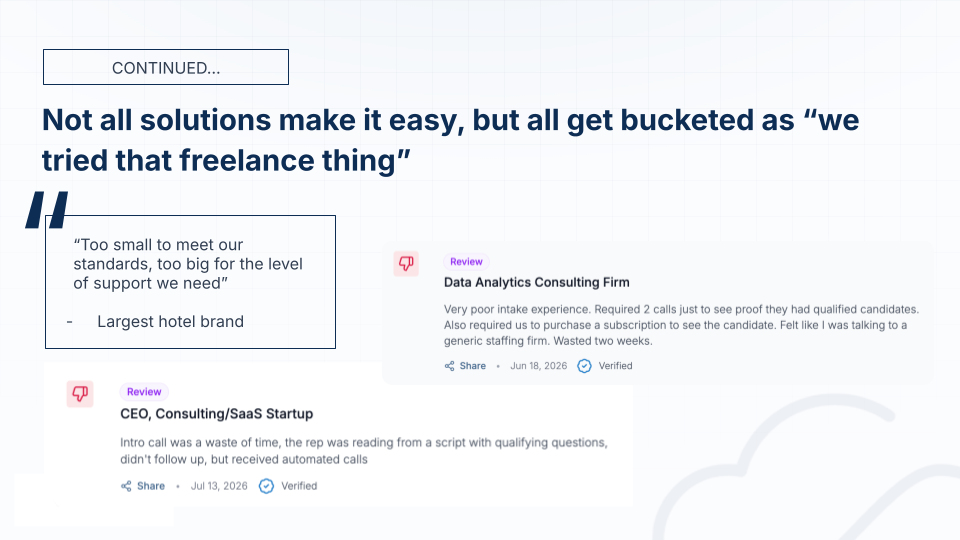
And that second slide is the part that compounds. One bad intake experience doesn't get filed as "that vendor was bad." It gets filed as "we tried that freelance thing."
Fractional doesn't detract, it adds to this complexity, fragmentation, and overall overwhelming size of an industry. And in mature environments, it adds another dimension of challenge: the personal risk of hiring your replacement. If you're the CMO, are you seeding your demise by hiring another CMO?
The reality is fractional is part of the rewire
The reality is that companies need to rewire their workforce from fixed and fragile to flexible and resilient.
If they don't, they'll be too slow, too general, and spend valuable time negotiating severance instead of defending their markets.
This rewire, I believe, is best understood as transitioning to the human cloud, a structural shift away from traditional staffing and contingent solutions to flexible talent solutions. Some customers love to call it the human layer of the agentic workforce. Others are loving Rich Wilson's coined term, the 40-40-20 workforce. And all are loving Tony Buffum's framing, from talent acquisition to talent access.
No matter what we call it, it's a shift away from default full-time to default flexible, default resumes to default digital profiles, and default lengthy job reqs to capability-based talent access.
How to get it right: companies have to get the partners, processes, and tech stack right
Whether you want it to or not, flexible talent is in your organization today, and will only be a larger share tomorrow. A dirty secret in organizations is that 60% of talent spend is deemed "rogue," meaning it isn't processing through traditional programs and channels.[3]
The data backs this, as 94% of fractional executives win work through referrals, while just 19% have won work through a talent platform and 11% through an executive search firm.[6]
This works fine if you're a founder hiring a friend's former CFO. It breaks if you're a mid-market or enterprise org who can't contract an independent directly without classification, payroll, and compliance infrastructure sitting underneath it.
Which brings up the opportunity - flexible talent will happen no matter what. If you want it to move your org forward, get these 3 things right.
Partners
Companies can't do it alone, and a Deloitte PPT deck doesn't help.
In the case of fractional, there are phenomenal fractional talent platforms ready to help you scope and support the work.
Process
Flexible work is a new talent strategy that requires new playbooks, new governance, and new SOPs.
It mostly simplifies, but it definitely breaks norms and existing processes.
Here are the most common differences:
- It replaces interview loops with low-risk contracts, where you can more accurately detect whether it will work
- It replaces resumes with digital profiles
- It puts higher importance on classification-related controls
Tech Stack
The modern talent OS runs on 3 distinct processes.
- Source: finding net new, highly specialized, highly vetted talent
- Support: helping hiring managers and leaders plan and manage their workforce
- Scale: compliance, payroll, EOR/COR/AOR
The right stack is different depending on your organization.
A word of caution: you probably shouldn't disrupt
As a founder building flexible talent models since 2012, I've seen the graveyard full of founders and executives trying to disrupt the existing talent infrastructure.
Hop on the podcast if you want to deep dive this. But the reality is that talent is a B2B, highly relational, highly subjective, and not sexy industry. Success comes from partnership and deep relationships over anything product, technical, or GTM related.
This means if you're the internal executive leading this, don't do it without your procurement, HR, or legal team. You'll have fun until you hit $1M in spend, then get cut off.
Or if you're the founder, don't discount the VMS, the MSP, and the thousands of staffing firms companies already trust. And if you're leading a fractional solution, discount the existing talent platform world at your own peril.
No matter your role, you're fighting the good fight, and building a world that works.
- Matt
Sources
- Human Cloud, State of the Freelance Industry, July 2, 2026. The Venture Cliff and The M&A Cliff. humancloud.com
- MBO Partners by Beeline, 2025 State of Independence in America Report, 15th annual edition. 72.9M independents; 67% feel more secure; nearly 80% plan to stay independent or grow; 5.6M earning $100K+, up 86% since 2020. https://www.mbopartners.com/state-of-independence/
- Human Cloud platform data, August 2026. Solution counts, industry CAGR, and engagement experience across $1B+ of flexible talent spend. humancloud.com
- Rich Wilson, gigged.ai growth update, LinkedIn, 2026. 52% month-over-month revenue growth May to June; 284% revenue growth over 12 months. https://www.linkedin.com/posts/richlwilson_sow-customersuccess-growth-activity-7484872239507644416-pdU9
- Matthew Mottola and Matt Coatney, The Human Cloud, HarperCollins Leadership, 2021. Get the book
- Fractional Jobs, The Fractional Work Report 2026, July 2026. Platform data n=1,447 postings and n=44,433 members; survey n=1,733; 166 client discovery calls. https://www.fractionaljobs.io
- Caitlin Lustig, Sean Rintel, Liane Scult, and Siddharth Suri, "Stuck in the Middle With You: The Transaction Costs of Corporate Employees Hiring Freelancers," Microsoft Research, CSCW 2020. https://www.microsoft.com/en-us/research/publication/stuck-in-the-middle-with-you-the-transaction-costs-of-corporate-employees-hiring-freelancers/
- Human Cloud, How to Make RFPs a Growth Driver for Your Business, 2026. Our Industry Is Too Hard, and buyer reviews. humancloud.com
Get insights like this every week
Join 26,000+ leaders staying ahead of the flexible talent market.